Monday, 10 March 2014

What is your fitness age?

So how fit do you think you are?
Run 5k's, cycle half marathons? Are these the true tests of fitness?

I'm not sure either.

It's an incredible feat for sure. However the recent rise in young and "fit" athletes suddenly dropping dead on the field due to cardiac arrest or heart failure, is a cause for concern.
How hard should we be pushing ourselves, before the optimal point is passed and it becomes more destructive than constructive.

But that is for another post.

Right now I've come across another hot topic - fitness test calculators. (I thought I'd credit the blog where I first came across this fitness calculator. If you love MMA, head on over to this sister's site: PrettyTuff.co.za)
Maximal oxygen uptake or VO2 max is the capacity of the body to transport oxygen during incremental exercise. Measures physical fitness.

This calculation is researched based. Questions focus around lifestyle and heart rates.
Physical fitness is heart health and moreover the ability of the body to transport oxygen during incremental exercise. I guess this makes sense, since we associate a fit person with someone who doesn't huff and puff like they are constantly trying to catch their breath. If you're getting enough oxygen, then your body wouldn't demand it of you through extra heavy breathing.

This is called maximal oxygen uptake (VO2 max). Your test results will be given in this measurement as well as your fitness age. I bet you can't wait to find out your fitness age?

Just hang on a bit for this bit of healthy advice:

The idea is that you can have the same VO2 max as a much younger person, with exercise, healthy eating and avoiding sedentary lifestyles. Although nothing can make you live longer than the date arranged for you by Allah (SWT), staying fit is a way to look after the gift of a physical body given to us, and a healthy strong body at any age definitely makes life easier.

So what is your fitness age? I was five years younger than my actual age. And my VO2 max reading was equal to that of an average woman in my own age group. Although I'd like to read a little more positively into it, since my age is on the upper end of this age group; if I maintain this VO2 max result into the next year, I'd be above average and getting younger! Physically-fit-younger, that is.

Find out your true physical fitness age now.


Tuesday, 25 February 2014

Yoga: engaging in shirk or not?


I've recently dabbled into YOGA. There was a free dvd in a health magazine and I tried it out.

I found it quite relaxing and calming, unwinding my tense muscles after a long day, in a different way then regular exercise. All the deep breathing and pausing had a calming effect on my impatient self.

The challenges of the poses, listening to the instructor, trying to balance myself - all had a profound impact in getting my monkey-mind into focus. It was mindfulness in its true form. I could think of nothing else except what I was doing at that very moment. What's more is that afterwards, my body felt light and more flexible, removing the day's tightness from my muscles.

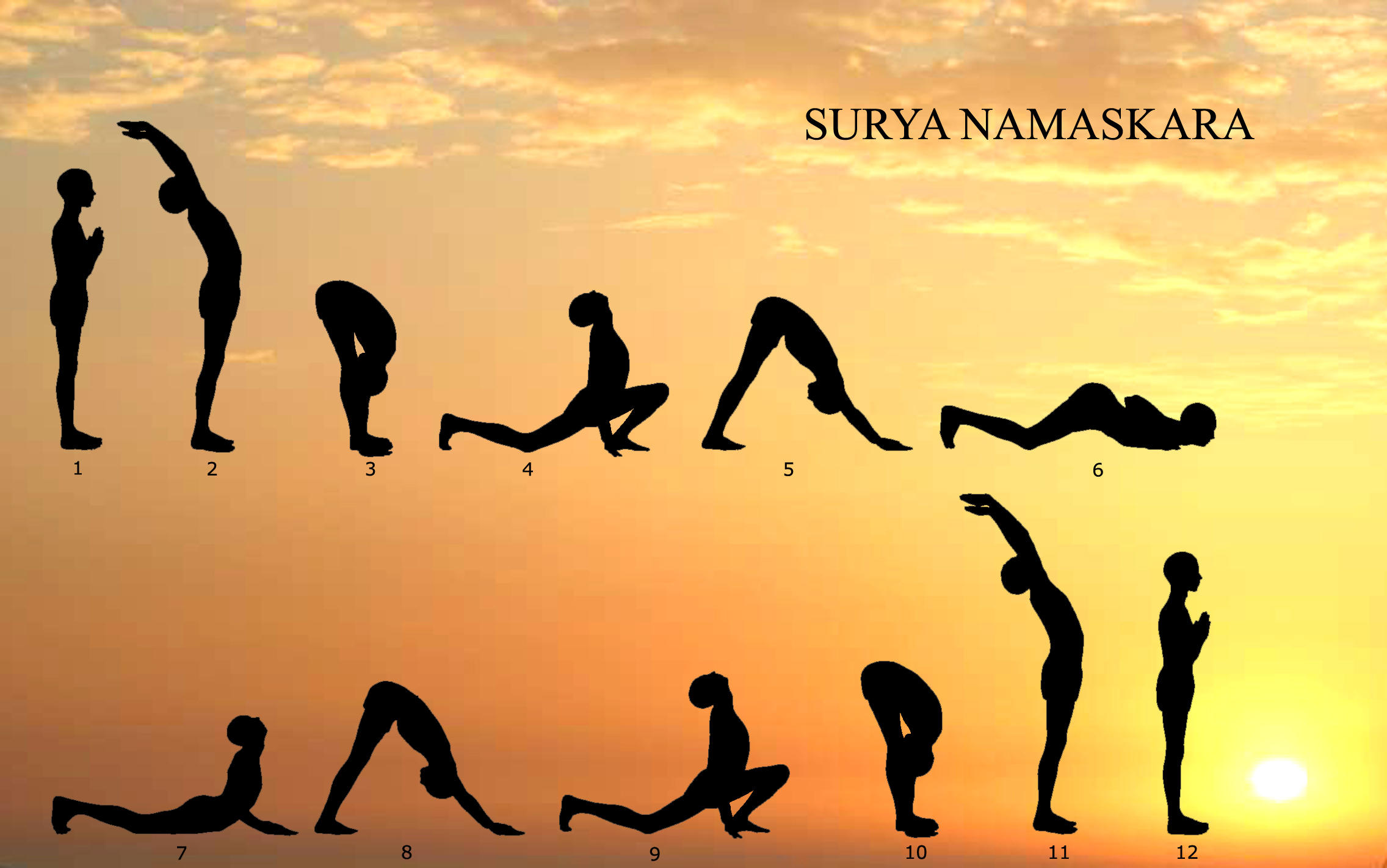
However something bothered me a little: The instructor referred to certain series of poses as sun salutations. Immediately I didn't like the sound of that. It sounded like worshipping or praising the sun! And when I think of the poses, they seem like prostrations and offerings. There was one particular pose, no 3 in the picture below, which the instructor said you could put your hands on your shins with a flat back  - felt like I was in rukuh. At first that felt great because it just goes to show the possible health benefits that movements of salaah could have. But what was I making rukuh to?

Since there was no chanting of ohm's or other words, and since all the instructor did was pose and tell us when to breathe, I continued with it.

But the question still nagged me - does practising the sun salutations as exercise with intention of exercise and meditation, still amount to shirk or lead to shirk?

Before we continue, let's clarify what shirk is. Shirk is the association of partners with Allah (SWT). Since our very identity as a Muslim is to believe in one God, one Creator, one Sustainer, one Provider, one Most Merciful, one Protector etc.. then anything we take as a replacement for Allah (Swt) for any reason, leads to or amounts to associating partners with Allah, shirk.


The series of poses for "sun salutation" in yoga
Allah (Swt) is the ultimate Source. Whatever we want or need, it comes from Allah (Swt). Shirk is tricky and a great tool for Shaytaan in slowly misleading people. It's tricky because it is so easy to fall into it. The moment I put something above Allah or equal to Allah or obey over and above Allah (swt), like a person, a way of life, a need or desire, wealth, freedom, philosophies etc then I am being lead towards associating partners with Allah. A sure path of loss in this world and the next.

As always, there are differing opinions on this. A few years ago a fatwa was issued in Malaysia urging yoga to be banned for its associations with hinduism. Before I cry and mourn the loss of a newfound exercise, let me think of what I'm holding onto and what I'm walking away from.

I'm holding onto a calming and meditative form of exercise, with healing benefits for illness as it stimulates the part of the nervous system which counteracts stress and disease-causing effects in the body.

I may be walking away from Allah, taking a tiny step further away from Allah instead of getting closer towards Allah. Allah - The ultimate Source of health, tranquility and salvation in this life and the next.

That's not a difficult choice! If I give up yoga for Allah, there is no loss! In fact, I gain more.

This was my choice already before I set out to find answers from the great modern oracle: Google. (sorry couldn't help that one - Google has become like an oracle. Type in a question, get an answer)

Links to articles I found insightful:

1) Yoga is haraam: http://islamqa.info/en/101591

2) Yoga is halal only without the chanting and spiritual matters: http://muslimmatters.org/2008/12/24/breathe-in-breathe-out-ohmmm/

I guess I'm with number 2; yoga is halal without the religious chanting and spiritual context.

But I'm wary of yoga now.

To be a true master, you need to delve into something completely. I like to master crafts and activities. So this means I need to be mindful of my restrictions in practising yoga. I could never be a true yogi, which in the first article means to try and unite with the spirit and God, seeing all religions, including Islam, as incomplete truths. 

Yoga, tai chi and other ancient forms of martial arts and exercises often have a spiritual foundation which may be contrary to believing in the oneness of Allah, leading to shirk.

In practicing yoga and other ancient forms of exercise and meditation, while attaining mindfulness and inner peace, we should be mindful too of the fact that it is best to restrict these practices to the exercise form only. 

In this case, western forms of yoga, which is physically based and only focuses on poses and breathing leaving out the spiritual element, may be the best one to practice. Some are really useful for stretching hip flexors, great for women!


However, I'm a little put off by the sun salutations part of yoga. I can get the same mindfulness from regular exercise just by continuously challenging myself, adding weights for example, trying new routines and sports. I hear pilates, which involves stretching and breathing too, is similar to yoga with no religious affiliation or names like "sun salutations". 

Good intentions or not, these ancient exercises are meant to touch your soul, move it (to where?), and the poses have a purpose inclined to that spiritual belief. Just like prostration in salah has a purpose of humbling ourselves in our natural position before Allah, a position acknowledging His Superiority over us. It humbles the soul, moves it towards believing in one God.

Letting go of yoga completely may not be so bad. That would be ironic, since yoga teaches to LET GO of what does not serve you.


I leave you with this mindful ayat:


Wednesday, 18 December 2013

Hate exercise? - a powerful solution

According to one article I read, most women do not like to exercise or do sports.


MERMAID POSE in PILATES


I'm not surprised. Personally I hate exercise. All those reps and circuits can get so boring.
Sports was more my thing. Especially team sports.
Playing a sport is what people do together, and so it becomes more about the social aspect of the activity instead of the activity itself. But it requires a level of commitment that most women cannot give when they're building careers and families. Nobody wants to let their team down by not showing up because they had to work late or attend to their families.

So we're left with exercise as the only way to keep fit and healthy. Bleh!

Each minute, each rep feels like a lifetime.


I've tried many different approaches to this, to try and enjoy it and hopefully do more exercise.

But it doesn't change the boring-ness of exercise.
Sports was also a mental game. There was strategy involved.
Exercise only requires that you're able to count reps.

So if you're not a gym-bunny nor an exercise junkie, what's next?


Forget the motivational quotes and pep-talks. It doesn't work here, and doesn't last longer than that first minute into the exercise routine.


When you know you have to do something about your weight, your health or your fitness and you don't have a personal trainer to push you and hold you accountable, then there's only one thing left to do. 


In the words of another famous sports brand: Just do it!


GOOD OLD FASHIONED ROPE SKIPPING


Saturday, 9 November 2013

Sports hijab and athletic performance - addressing key factors

Back in my netball, tennis and very active sports playing teenage days, which have since been replaced with family duties, I read an in a sports magazine about how athletes use all their senses when competing.

Watch an ATP tennis match. Pick any of the fastest servers in the league and you'll see that they hit the ball so hard that travels towards their opponent at speeds over 220km/hour!

I doubt any of their opponents can see the ball coming towards them. Perhaps all they can make out is a yellow streak. But it's so fast, it's difficult to judge with eyesight alone the direction it is going and precisely where it is going to land. Getting there before it bounces past them, is difficult.

According to the article I read, hearing the ball being hit and landing nearby, helps to judge more accurately it's direction. Hearing the THWACK of it being hit by your opponent, gives an idea of timing, of when to move. Together with eyesight, judging the ball's direction and timing it's landing is easier with teamwork of the senses.

Now for a hijabi girl, this may be problematic. Layers of fabric over the ears can affect hearing, particularly if there is more than one layer.  More denser fabrics can flaps against your ears causing distracting and annoying noises.

That day, many years ago, I thought to my teenage self, This is it!
This is what Muslim women's sportswear is all about. It's not just style, design and colours. But functionality and performance enhancement too. That day I sketched my first design. And improved on it a little at a time.


The new sports hijab Pioneer 800 range has less gathering of fabric at the neck and a longer, though compact front panel to cover small to larger chest sizes. It's a simpler design, offering comfort and modesty.


In the side-view sports hijab image above, I've edited the picture to emphasise the seams in the design. Two seams are visible, but neither cross over the ears eliminating noise caused by friction and irritation on the ears.

The Pioneer 800 range of sports hijabs, are based on the previous design of 2012, the Pioneer 700 range. However, the inner head band was removed as it added another layer over the ears getting in the way of a key factor I wanted the sports hijab to have. 

Like the 700 range, it comes in FIVE different sizes to give you the best balance between secure fit and comfort. Not to mention TEN different colours to choose from. And the fabric - it is still the same quality, moisture-wicking, quick-drying, breathable, lightweight fabric, designed for sports. All to keep you cool and dry while you play free.

*Currently retails for BWP320 or USD 37 or EURO 27 or MYR 117 or SGD46

Friday, 8 November 2013

Sports bras - Bounce control

If you are the type to wear your everyday bra to the gym or that iron-woman marathon, you may be jeopardising your breast health. Shockingly, 75% of women do not wear sports bras when exercising or doing sports!


Most sports bras are made to be worn on their own without any need to wear a shirt over it.
But covering up modestly does not mean you can toss on any bra that is in your undies drawer.


Sports bras have a very important function - protecting your breast tissue.

Exercise and sports involves a lot of fast, jerky movements. When your body quickly changes from one direction to another, the weight of your body plays against you. Great for toning and weight-loss, but bad for unsupported breasts. More specifically, the heavier your breasts the more damage is done by the sheer weight of the breast tissue itself. The larger your cup size, the more damage is done. Talk about attacking your own body!

Exercise, while good for overall health, can stretch ligaments that keep your breasts firm and (ahem) above your waistline. High impact exercise can damage the breast tissue itself which can be the cause of many other ailments in the long term. More commonly and cause for concern, exercise is one of the biggest causes of breasts sagging prematurely. Breasts have no muscle support, so once they sag no amount of toning or exercising is going to lift it back up again.

So now that you're convinced in switching your regular bra for a sports bra when you hit the gym, what next?

Choose the right one for your size with consideration of your type of exercise.
Higher impact activities require stronger support.

Sports bras styles such as the black and white duo below, are okay for A-cup to B-cup sizes, for any activity of low to high impact intensity. Though you may want to consider stronger support just to be sure. Larger cup sizes could wear these for low impact activities such as yoga, lifting light weights. 
The T-bar at the back is the main support of this bra, as it pulls your breasts closer to your body, not allowing them to swing in all directions which is the cause of tissue damage.


For stronger support, a must for C-cup sizes and above, consider sports bras that support each breast. They look more like regular bras, and may or may not have underwire. This purple one below, does not have underwire. 


The peachy coloured one, below has a definite shape to it supporting each breast and avoiding the one-boob effect. The stretchy fabric is part of the compression technology, which basically means it presses your breasts against your body restricting movement. 

Straps that criss-cross  at the back give it the support it needs for higher impact sports. Although not required, wider straps offer more support. Waistbands that can adjust width like a regular bra are a bonus ensuring a perfect fit everytime.


When fitting on a sports bra, the key point to remember is it should restrict movement as much as possible without feeling too uncomfortable or squeezing  too tight. You should be able to breathe easily, so that your body can supply oxygen to your brain when training!

Sports bras provide more modesty too. You don't have to worry about bouncing around under your sportswear as you exercise in the open. Everything is kept still and out of sight. Just the way we want it.


Tuesday, 5 November 2013

Hijab: Whatsit to you?

Hijab. It's such a loaded word. A topic that can polarise dinner party guests as quickly as dropping the word "carbohydrates" in a diet/weight loss conversation. It is so many things to so many different people.


Here is what hijab is to different people:
1. A representation of Muslim identity, and hence a sense of community is formed
2. A protest to modern day female objectification
3. The highest form of modesty
4. The highest form of Iman (belief in Allah)
5. A form of protection from unwanted male attention and advances
6. A form of protection from would be rapists
7. A form of true beauty
8. A cover that allows you to be taken at the value of your inner self, and not for your looks

Those are the good things, the 'promises' that we've all been told at one time or another about hijab.

There are also bad things about hijab, the list continues:
9. A burden
10. An unconscious mind-numbing habit, devoid of spiritual value
11. A people-pleaser
12. An obstruction and oppression against women
13. An outward appearance that covers up a 'bad' superficial personality

There is more to add to the list. But these are the common ideas of hijab that I've come across.
Are these false ideas? Do those 'promises' automatically come true for those who start wearing hijab?

A woman decides to wear hijab out of obedience to Allah (swt) hoping for its benefits, and then finds that some of these promises are never delivered. The truth is that hijab sometimes attracts more men, more unwanted male attention and advances. People still judge you for the way you look - in hijab! If you were hoping that you'd find a place in the Muslim community when you wear it, you may have been hurt to find you were shunned for some other silly reason anyway. These were all things we were told to encourage us to wear hijab. Sometimes these fall flat on their faces.

The same woman may continue on her hijab journey and a few years down the road, hijab becomes a burden, a habit. Since it never delivered on its promises, it seems somehow unnecessary. Even more so that she met really nice and pious Muslims who didn't wear hijab. She begins to question it all, "what is the point of it really?"

Haters may hate. And those that are perfect in themselves, will judge at this point.
But should she care? Not one bit.

Hijab is one small part of being Muslim. To those who have formed their identities around it, this is hard to accept. If you can get beyond the preaching moulanas and muftis who have over-emphasised hijab, and continue on your hijab journey asking questions, why? how? why? It may lead you to answers that bring you closer to Allah (swt). It's a scary path to take, because there are few who do it so boldly.
You lose friends, you feel alone. Yet, in truth we are always alone, with Allah (swt). What difference does it make?

Hijab is also a trial. It's regretful that it has come to a point where some people feel that once they wear it, their religion is complete. There is more to being Muslim than only wearing hijab.
Let's start with the five pillars, then there is kindness, charity, humility, over-coming ego, honesty, tolerance and consideration, gratitude...

I'm a choice person. Not a choice grade person, but a believer in free - will and making your own choices.
If your hijab journey leads you to a decision to remove it, for whatever reason, that's okay. Hijab can be an on and off thing. Perhaps not lawfully, but by its nature wearing hijab is a task. I don't think removing it lessens iman, or makes anyone less of a Muslim.

We all have to find our journey in Islam. It is not going to be the same for everyone. Some find it easy to wear hijab, and love it. Others struggle a little bit more with it, and yet find every other part of practising Islam a breeze.

In the end though, Allah (swt) mentions in Quran more of ingratitude and ungratefulness for His blessings and mercy than about wearing hijab. Arrogance is what gets punished throughout the revelations. That's a clue as to what is really important in life. Hijab is such a small part indeed. 

When you feel overwhelmed by something, it is a good thing to step away and step out of that overwhelming thing. This may or not mean, making a decision to remove hijab. That is a completely personal decision. 


Thursday, 31 October 2013

Muslim women in Sport: culture vs religion

My article in Aquila Style online magazine. I did a little research into Muslim Women in Sport, particularly the restrictions imposed on us by culture and religion.

Click the picture to follow the link to the article.

Kulsoom Abdullah - weightlifter